A Rules-Based Practice · Smart Money Aware

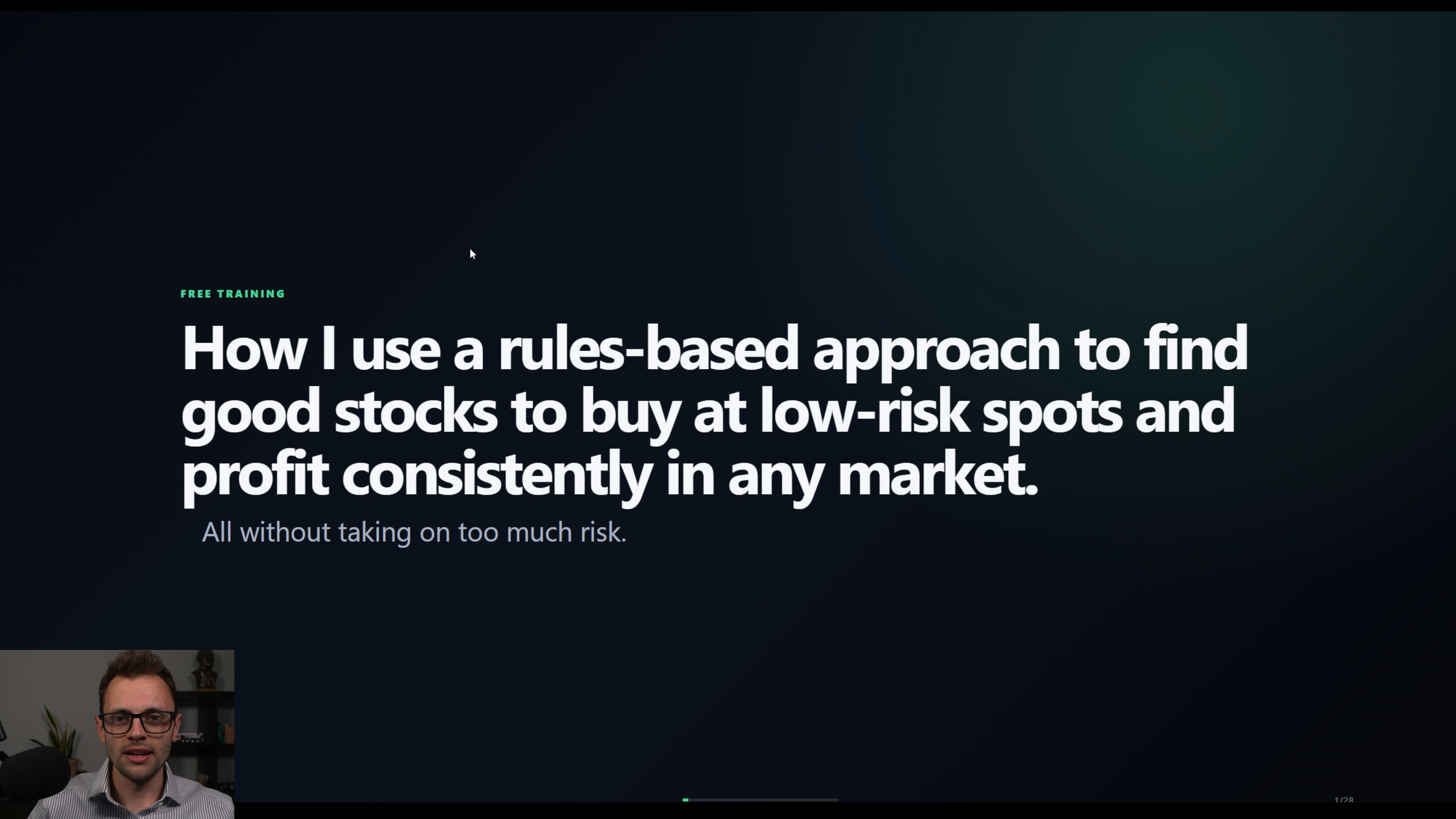
A rules-based method for outperforming the market, without ever taking a large loss.

This process is straightforward and learnable. Identify high-probability setups with a defined checklist. Confirm them with the institutional capital that moves markets. Define your risk before you enter, and let an automated process replace emotion. The result is consistent participation in the market's biggest winners, with the downside contained by design.


Pillars of Confirmation
III
Smart money flow, a good chart setup, and a solid stock. A position is taken when all three agree. When they do not, the trade is not forced.
Criteria Before Entry
VII
Seven conditions must be met before any position is opened. The checklist removes opinion from the decision and replaces it with a measurable test.
Hours Per Week
~5
A weekend scan, a few weekday check-ins, automated stops doing the rest. Built for investors with jobs, families, and lives outside the market.
Risk Defined
Always
Every position has a defined exit before it is opened. If you cannot say where you are wrong, you should not be in the trade.

Learned from the greats. Updated for the market we actually trade.

Most of what gets taught about investing is performance, not method. Predictions delivered with confidence. Narratives written after the fact. The work of consistently outperforming the market is quieter, more disciplined, and more learnable than most people are told.

The foundation comes from the work of investors who studied the market for decades before any of us got here. William O'Neil's CAN-SLIM framework, built from forty years of research on the biggest winning stocks, identified the recurring DNA of a market leader: cut losses small, own leaders not laggards, buy strength not weakness, and respect the broader market's direction. These ideas are still right.

What they did not have is the modern market. Institutional options flow tracked in real time. Dark pool prints made public. The unusual activity of the funds with the most capital and the best information now visible the same day they take their positions. Smart money flow is the layer the classics could not see.

This practice keeps what works from the foundational thinkers and adds what they never had: a smart-money-aware, risk-managed, modern execution layer. The principles are old. The tools are new. The combination is what makes this work.

The market is not something that happens to you. It is something you navigate with rules.

Most investors lose because they have no system. They guess. They chase. They let emotions drive every decision. A position goes against them, they hold and hope. A position works in their favor, they sell too early out of fear. The result is the same in every cycle: inconsistent returns, large drawdowns, and the feeling that the market is something that happens to them.

The premise of this practice is simpler than it sounds. Define your risk before you take a position. Follow the capital that moves markets. Let a rules-based process replace emotion. You do not need to predict the future. You need to identify high-probability setups, manage your downside, and let the winners run while cutting the losers early.

This is not only for active traders. Anyone with a long-term portfolio benefits from learning when to step aside. The investors who get hurt most in a major correction are usually the ones closest to retirement, the ones who cannot afford to wait five or ten years for a recovery. Knowing how to recognize a confirmed market downtrend, and having the discipline to act on it, can be the difference between protecting a lifetime of compounding and watching it cut in half. The rules do not take much time to learn or apply. What they protect is everything you have already built.

"Stock picking without rules is gambling. You might get lucky. Luck does not compound. A skill-based, rules-driven approach does."

What separates investors who outperform from investors who do not is rarely intelligence and almost never information. It is the willingness to act on rules when the rules are unpopular. To pass on a position that "looks good" because the smart money is not there. To take a small loss without flinching. To stand aside in a market that is not giving permission. To size to your written conviction, not your hopeful one.

This is a skill. Once you develop it, you have it for life. It takes a few hours a week, not a full-time commitment. And it works in any market environment because the principles are rooted in risk management, not in being right about direction.

Six operating rules that do not change with the market.

I.

Define your risk before you enter.

Every position has a stop loss set before the trade is opened. Sized small relative to the account, automated at the broker, and not negotiable once the position is live. If you cannot say where you are wrong, you should not be in the trade.

II.

Follow the capital that moves markets.

Institutional options flow, dark pool prints, and unusual activity tell us when the funds with the most capital and best information are taking positions. We do not blindly follow them. We use the data to confirm what the chart and the fundamentals are already suggesting. When all three agree, the probability shifts in our favor.

III.

Cut losses small. Automatically.

Small, planned losses are the cost of doing business. A managed loss is the price of staying alive across a thousand trades. The investors who never recover are almost always the ones who let a single position destroy a year of careful work.

IV.

Buy strength, not weakness.

Stocks breaking out at new highs on confirming volume are being accumulated by the right kind of buyer. Stocks that are "down a lot" are usually down for a reason. Strength is information. Weakness is rarely an opportunity in disguise.

V.

Honor the market's direction.

Three out of four stocks follow the broader market. When the indexes are in a confirmed downtrend, the right answer is cash or the short side. The best system in the world will lose if you fight the tape. Knowing when to stand aside is half of this work.

VI.

Preserve capital so you can redeploy it.

Capital locked in a losing position cannot work for you. Position sizing protects the portfolio. Quick exits free the capital to find better setups. The goal is not to be right on every trade. The goal is to keep losses small and let winners run.

Seven criteria. One checklist. Every position must qualify.

A trade earns a position when all seven conditions are met. None of them are negotiable. The framework removes opinion from the decision and replaces it with a measurable, repeatable test that has held up across every kind of market.

I
Criterion 01The Chart Setup
A clean, actionable pattern from a defined list. Breakouts from consolidation, pullbacks to key moving averages, well-formed bases. The chart has to be doing something specific, not "looking interesting." If the structure is not there, no other criterion matters.
II
Criterion 02The Trigger
A specific technical event that tells us the setup is now in motion. A confirmed breakout above resistance. A reclaim of the 8 or 21 EMA on rising volume. We do not buy because a stock looks good. We buy because a defined trigger has fired.
III
Criterion 03Smart Money Confirmation
Institutional options flow, dark pool prints, and insider activity that confirm the chart's story. Significant directional bets, longer-dated, sized at conviction levels. When the largest, best-informed players are positioning the same way the chart is pointing, the probability shifts in our favor.
IV
Criterion 04The Fundamental Story
A real business doing real things. Accelerating earnings, durable growth, a product or position that justifies the move. Not a story stock, not a meme, not a hope. We participate in the moves that have a reason to keep going.
V
Criterion 05Industry Leadership
In every industry group there is a leader and there are imitators. We buy the leader. Relative strength against the broader market and against its own peer group is the test. Below that threshold, the stock has not yet earned the position.
VI
Criterion 06The Market Context
The most important criterion, and the one most investors ignore. Three out of four stocks follow the general market. When the indexes are in a confirmed correction, no setup is good enough to override that context. The right answer is cash, or the short side, or patience.
VII
Criterion 07Defined Risk
Every entry has a stop loss set before the position is opened, sized so a single loss never threatens the portfolio. Position sizing calibrated to conviction. Exit plan written before entry. The trade is built around protection, not hope.

The same patterns, repeated for decades.

The same handful of errors account for nearly all underperformance among individual investors. They are not exotic. They are not subtle. They are the patterns that intelligent people fall into every cycle, often because no one ever wrote them down where they could see them. Recognizing these is not a small piece of doing this work well. It is most of it.

No. 01

Buying on the way down.

A declining stock looks like a bargain because it is cheaper than it was. The decline almost always continues. Strength is a signal of accumulation. Weakness is rarely an opportunity in disguise.

No. 02

Averaging down on losers.

Doubling a position because it is at a lower price is doubling down on the wrong idea. The first purchase has been refuted by the market. The second is a reluctance to admit that.

No. 03

Holding losses, hoping for recovery.

The most expensive sentence in investing is "I'll sell when it gets back to even." The losses get bigger. The investor gets paralyzed. The capital that could have been working in a leader is locked in a laggard, waiting.

No. 04

Taking small profits, holding losses.

Exactly backwards. The right behavior is to take small losses and let winners run. The instinct to lock in gains while a position is still working is the surest way to convert an outperforming year into an average one.

No. 05

Refusing to buy at new highs.

Roughly 98 percent of individual investors will not buy a stock making new highs. It feels too expensive. The greatest winners of the past forty years all broke out at new highs first. The instinct that feels safe is the one that costs the most.

No. 06

Buying on tips and stories.

Most rumors are wrong. The ones that are right have already moved the price. A position bought on a story has no exit plan because it had no entry criteria. Tips are how amateurs lose money to professionals.

No. 07

Buying familiar names without studying them.

Working at a company, owning its products, recognizing the logo: none of those things are an edge. Many of the best opportunities are in names most investors have never heard of, doing things they have not yet read about.

No. 08

Investing without a written set of rules.

Investors who hesitate, who change their minds, who cannot decide whether to buy or sell, almost always lack a system. The rules eliminate the need to decide in the moment. They were already decided in advance.

A practitioner first, a teacher second.

[ Portrait of Matt
Editorial, single light
Cream or charcoal ground ]
Matt New York, New York

I started in markets the way most people do, by making nearly every available mistake. I read every book. I followed every analyst. I confused activity with progress and confidence with edge. The lessons were expensive and they were worth what they cost.

What changed everything was learning to study the work of investors who had already done the hard part. The CAN-SLIM framework, in particular, gave me a foundation: rules instead of opinions, leaders instead of laggards, defined risk instead of hope. The classics are still right about most of what they wrote.

What the classics did not have is the modern market. The ability to see institutional flow in real time. The dark pool data. The unusual options activity that signals where the largest, best-informed players are positioning. Layering that on top of a rules-based foundation is what turned a decent strategy into a consistent one.

I teach because the questions I get asked are the same questions I once asked. The work is to give honest answers and put the system somewhere serious investors can find it.
— Matt
Practice Independent research and mentorship combining classical methodology with smart money flow analysis. Equity markets, US large- and mid-cap leadership.
Approach Rules-based. Risk-managed. Position-sized to written conviction. Built for investors with jobs and lives outside the market.
Tools TradingView with proprietary indicator suite, institutional flow data, weekly research letter, private community.
Not Practiced Day-trading services. Crypto signals. Tip sheets. Predictions. Promises.

Two paths into the work, chosen by fit.

The programs are organized around how directly you want to work together. The Edge is for self-directed investors who want the research, the framework, and the community. The Blueprint is for those who want the full curriculum, the indicator suite, and direct mentorship. Both begin with a conversation; we want to make sure the fit is right before anyone enrolls.

Tier I Self-Directed

The Smart Money Edge

$99 / month
  • Trade ideas with full reasoning, not just tickers
  • Daily chart breakdowns aligned to the methodology
  • Weekly watchlist published every weekend
  • Smart money alerts when the patterns confirm
  • Group calls and a working private community
Book a Call to Learn More

Recent writing on method and markets.

[Issue No. XXX] [Month, Year]

Why every great winner of the last decade broke out at a new high first.

A walkthrough of the eight largest market leaders since 2014, the chart structures they emerged from, and the new high breakouts that most investors refused to buy.

Read the letter →
[Issue No. XXX] [Month, Year]

What institutional options flow tells us that price action alone cannot.

Three real examples of trades where the chart looked uncertain and the smart money data made the call. How to filter the noise, what size and structure to look for, and where the edge actually lives.

Read the letter →
[Issue No. XXX] [Month, Year]

Three out of four stocks follow the market. Most investors trade as if they don't.

An honest essay on the discipline of standing aside, the cost of fighting the tape, and how to recognize a confirmed correction in time to matter for your portfolio.

Read the letter →

Begin a conversation.

Both programs begin with a conversation. Whether you are exploring the Edge or considering the Blueprint, the easiest path forward is to book a short call so we can talk through your goals, your experience, and which path makes sense.

Book a Call →
Subscribe
The free letter, weekly. No marketing emails between letters.
Inquire
matt@[YOURDOMAIN].com
Audience
Self-directed investors and practitioners. Not a service for managed-account clients.
Response
Within two business days, by Matt directly.